
Writing down thinking
Characters think things. Here's how to write them down.
Welcome back to the Writer’s Secret Weapon. I’m John, it’s nice to see you again. If you’re new here, I’m a writing coach and developmental editor and this is where I talk about writing in ways you won’t find elsewhere.
It’s so often the simple things that trip us up as writers. We’re people prone to over-thinking, to over-worrying, to assuming that something can’t be as easy or straightforward without there being some kind of catch or trick.
Like writing dialogue can’t possibly just be writing things and using quotation marks, right? We have all these other forms of punctuation, so they’ve got be used, right?
Or writing a pitch can’t be as simple as writing an evocative sentence that frames some portion of the story’s stakes and plot and character but doesn’t have everything because it’s a pitch not a book report, can it?
The easy stuff can get hard when we get all up in our heads over it.
Like “internals.” Now while the term is gag-inducing and is far more popular in social media circles than in editorial ones (pros call them “thoughts”), writing internals is pretty straightforward once you strip it down.
From The Desk Of The Brain Of The Character
An internal is what a character is thinking. The old-fashioned term is “internal dialogue” which later became “inner dialogue” which is now “internal” because we can’t just leave well enough alone.
It’s the thought they’re having. It’s the reaction they’re having. It’s the emotion being expressed through their thinking. It’s just a thought. Whatever the character is thinking, that’s an internal. Period.
How that material is framed comes in two types and then further divides along things like what tense you’re writing in and in what POV you’re writing in.
That’s it. No big giant complicated shit unless you’re bringing baggage to it.
Before we talk about types of internals, let’s get the presentation out of the way.
Put A Little Lean Into It
For the vast majority of thoughts the character is having, you’re going to italicize the sentences that are the thoughts. No quotes, no single quotes, no braces or parentheses or font change or any other typographical decision making.
If the character is having a thought and you the writer are writing that thought verbatim and presenting it to the reader, italicize it.
Like this:
I really want a sandwich. John stared out the window at the night sky. He should have been writing more. He should have been doing the dishes. But those things could wait, because he was thinking about sandwiches again. And not just any sandwich, one particular sandwich from one particular place, the cheesesteak from Reese’s Deli. He’d marry that greasy cheesy mess if he could.
Full Frontal Or Around The Back Door
Thoughts/internals are expressed to the reader in two different ways: direct and indirect.
Direct thoughts/internals are the thoughts presented to the reader verbatim. They’re the thought the character is having word-for word. They’re italicized. Whether or not you’re writing in first- or third-person doesn’t change the fact that the character is going to have that thought in first-person and that you’re going to italicize the sentence(s) that comprise the thought, like the sandwich example.
Yes, arguably, pedants will point to those sentences possibly shifting tenses when compared to the rest of the exposition, but they’re thoughts, so they’re governed by different rules than exposition. Also, no one gives a shit, so long as it’s clear for the reader to understand that the sentence(s) are thought(s) and other sentences are exposition.
You might also notice there’s no verb tag to the thought. There’s no verbatim thought written and then the sentence ends with comma-he-thought.
And that’s because you don’t have to do that. It’s italicized already. You don’t need the tag.
Indirect thoughts/internals are expressions of what the character is thinking, but it’s not expressed to the reader verbatim and they’re not italicized. They’re paraphrased or summarized or generalized.
Like this:
John thought Sally was way out of line for saying traditional publishing was better than self-publishing.
In an indirect thought, it’s still a thought the character is having, but the reader doesn’t get the exact transcription of it. We, the reader, don’t know if John thought Oh holy shit I’m going to scream if she opens her mouth, she’s way out of line for this or if he thought Fuck this lady, she’s as smart as a box of toenails. The specifics of the thought and the degree of intensity about the thought are left up to the reader to figure out, usually by reading more exposition and drawing their answer from context clues as the exposition continues.
There’s no tag here either, because the expositive sentence has the verb already in it and there’s no need to double up.
A direct thought takes the reader right to what the character is thinking, makes that thinking clear and known, and shortens psychic distance between reader and character (if you don’t know what that is, it’s the relationship the reader has to the stuff they’re imagining, think about the camera zooming in and the reader getting know more about the character).
An indirect thought is broader and allows the writer (that’s you) to shape more exposition and text without having to pause whatever you’ve got going on to dip into the character’s head.
One is not better than the other. One is not more common than the other. You’re going to use them both frequently in everything you’re writing.
Yes, You’re Putting Thoughts In Their Head
You’re in charge of what the character says, thinks, and does. You’re responsible for communicating those things to the reader over the course of the whole story.
Use a direct thought when you want to specifically clue the reader into what the character is thinking and being word-for-word exact is helpful for you in developing whatever point you’re making.
Use an indirect thought when the exact substance of the thought doesn’t matter in developing whatever point you’re making.
Yes you can do this even in media outside of prose.
Like in screenwriting, like this:
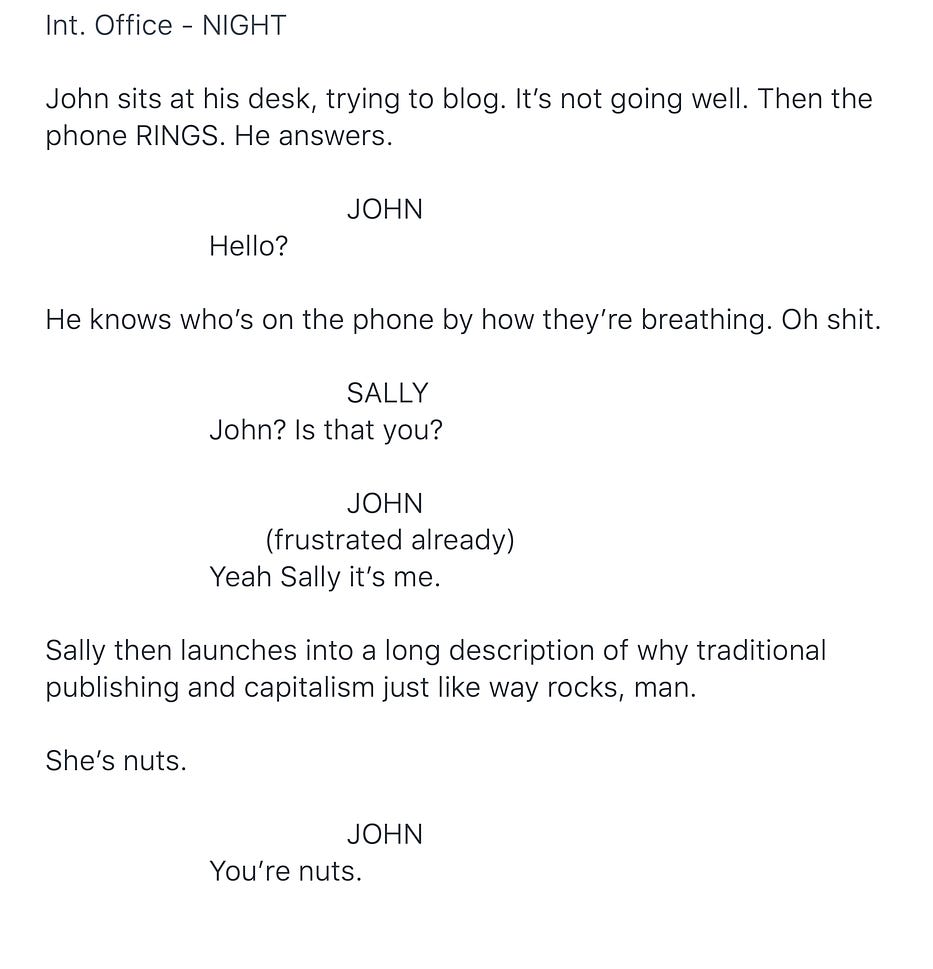
Here’s a screenwriting version
The indirect thoughts here are:
Oh shit.
She’s nuts
The parenthetical with John being frustrated helps shape the dialogue delivery while also expressing an indirect thought or set of thoughts about how John expects this interaction to go.
You can also make a case that the indirect thoughts are also direct thoughts because they’re being stated directly to the reader (screenplays can do that, it’s cool), and you’d be right. But again, that’s because screenwriting has different rules when it comes to how things are presented.
Or in sales copy:

In the first paragraph, all the sentences that end with exclamation points are direct thoughts, expressed to you by the nature of the marketing. They’re also direct challenges to problems (which is a salescopy thing).
The indirect thought is the statement that you’d be crazy if you didn’t make that call and buy the product. The person speaking through the copy isn’t outright saying “Hey you reader, you’re crazy if you don’t do this” but they’re saying you’re crazy if you don’t do this. It’s the same idea but it’s not being transmitted to you in the same way.
Let’s Wrap This Up Like A Mummy
Direct thoughts are thoughts the character has and you’re expressing them verbatim to the reader and they’re italicized on the page.
Indirect thoughts are thoughts the character has but you’re not writing them verbatim, so they’re not italicized on the page.
You don’t need to tag the thought like they’re dialogue if you’re quoting verbatim in about 90% of cases. And you don’t need to tag the thought if you’re writing an indirect internal because the sentence will either state or imply the verb already.
BONUS! You don’t need to tag the thought with a directive either like “to herself” because unless we’re dealing with telepathy or other supernatural forces, everyone’s thoughts are thought to themselves.
Was this post helpful?
Let me know in the comments. Love you. Talk soon.
I was genuinely about to reply with a snarky "Just write shit in italics" but, errr, carry on. As you were.
Hi John! It was very helpful for me to see the examples in several different formats.